

Organizations today face a critical question: What do we do when the talent needed to deliver our big organizational strategies isn’t ready?
The answer is not more identification of “high potentials.” It’s not more static training, and it’s not waiting for experience to accumulate over time.
A strong bench and true leadership readiness require challenging, applied learning experiences that stretch people in order to strengthen strategic problem-solving capability.
Without this, organizations operate with a false sense of readiness—a belief that successors exist, that the leadership bench is strong, and that succession plans will hold under pressure. In reality, when roles open or strategy accelerates or pivots, leaders are often not prepared to perform at the level required.
This is the great misalignment: the gap between perceived readiness and actual capability.
If you want help designing a readiness strategy that ensures your leaders are prepared, contact us.
*Register below to watch the webinar or read on for the recap.*
Download the free, complementary resource here: Talent Readiness Perception vs. Reality
The Cost of Inaction vs. the Cost of Leadership Readiness Spend
The consequences of this misalignment are not theoretical. They are measurable and significant.
Organizations without strong management & executive development capabilities take on:
-
- External executive search costs
- Slow leadership ramp-up
- Failed executive hires
- Failed internal promotions
- High turnover of high-potential talent
- Strategic initiatives that stall
Together, these issues can compound into costs of $2M–$10M+ annually.
Yet at the same time, many organizations hesitate to invest in talent development because they don’t link it directly to strategic priorities, the impact can be difficult to directly attribute to business outcomes, and the returns materialize over longer time horizons than most executives are incentivized to prioritize.
But the economics are clear: leadership development—whether through action learning programs, executive coaching, or leadership readiness coaching—often represents:
-
- $10,000–$50,000 per leader annually
- Or approximately $10K–$15K per leader in a structured, applied learning programs such as Action Learning
The comparison is direct:

When framed this way, the question is no longer whether to invest, but whether the organization can afford not to.
Why Succession Planning Breaks Down
Most organizations have succession planning processes. They identify talent. They assess potential. And they build lists.
Yet when the moment comes to promote, the reality that presents itself is much different from what they had on paper.
Successors are:
-
- Unproven in complex, strategic environments
- Unprepared to lead at enterprise scale
- Not equipped to solve ambiguous business challenges
The issue then isn’t the identification of these people, but the development of them.
Leadership assessments can indicate potential, but they do not create readiness. Readiness is built through:
-
- Exposure to real business challenges
- Opportunities to drive outcomes
- Situations that require cross-functional influence
- Environments that test judgment under pressure
Without this, succession plans remain theoretical.
The Root Cause: A Misalignment of Expectations
At the center of the problem is a fundamental misalignment.
Employees expect to be valued, rewarded, and promoted. Organizations expect performance, better outcomes, and alignment in values.
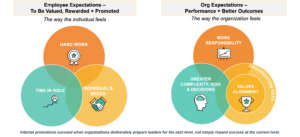
This misalignment creates friction.
High-potential leaders believe they are ready because they have performed well in their current roles. Organizations assume readiness based on past success and assessment data.
But readiness for the next level requires something different:
-
- The ability to solve new and unfamiliar problems
- The capacity to lead beyond functional expertise
- The discipline to deliver results through others at scale
How to Close the Gap (Practical Steps)
Organizations can address this misalignment immediately by:
1. Redefining readiness criteria
-
- Move beyond performance metrics
- Define readiness as the ability to handle complex, ambiguous, enterprise-level challenges
2. Aligning development with real business priorities
-
- Assign leaders to critical strategic initiatives
- Ensure development work produces tangible outcomes
3. Making expectations explicit
-
- Clearly communicate what is required for promotion
- Tie advancement to demonstrated capability, not tenure or potential
4. Embedding feedback and coaching
-
- Use executive coaching and leadership coaching to reinforce learning
- Provide continuous, real-time feedback tied to performance in applied settings
What Actually Builds a Strong Leadership Bench: Action Learning as a Core Mechanism
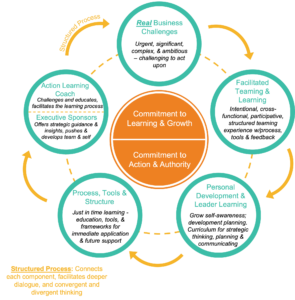
A strong leadership bench is not built through classroom training or theoretical learning alone. It’s built when people are placed into real business challenges where they are required to work on problems that matter to the organization and produce outcomes that the business actually needs.
This is where applied action learning programs such as Action Learning play a critical role. An Action Learning program is designed to give leaders the opportunity to work on critical strategic initiatives (not simulations or case studies) that require them to navigate complexity, align stakeholders, and drive results.
In this environment, leaders are not just learning concepts, but applying their thinking in real time, working cross-functionally across the organization, and being pushed to operate at a higher level than their current role requires. They are expected to analyze the situation, make decisions, and deliver outcomes while being visible to senior leadership.
This kind of experience creates a very different level of development. Leaders are stretched and challenged. They are required to think differently and operate beyond their functional expertise. They gain executive visibility and have the opportunity to showcase their potential in ways that traditional development programs do not allow.
At the same time, this work is paired with personal development and coaching, which helps leaders process the experience, reflect on their performance, and strengthen specific capabilities required for the next level. The combination of real business impact and focused development accelerates readiness in a way that is both practical and measurable.
And this is what ultimately turns a perceived bench into a leadership bench that is actually prepared to step into critical roles and deliver.
What This Means for HR & Talent Leaders: How to Close the Gap
The role of HR and Talent leadership is to ensure:
-
- The bench is ready
- Succession plans are tested
- Development investments produce measurable outcomes
This requires a shift that positions management & executive development as a core business investment by demonstrating that it’s a business performance lever, not a support function and not a “cost center.”
That means HR & Talent leaders have an opportunity to reframe the internal conversation from:
“development programs” → execution capability
“training investment” → risk mitigation and performance acceleration
“high-potential pipelines” → ready-now leadership capacity
Because the cost of getting this wrong is substantial:
-
- Failed executive hires can cost 2–3x salary
- Leadership transitions can delay strategic initiatives by 6–18 months
- Underprepared leaders reduce team productivity and increase attrition
The most effective next step is to start by evaluating where your current leaders have not yet been tested and create opportunities for them to be stretched in ways that matter.
If you are evaluating how to strengthen your bench, succession planning, and leadership readiness, the next step is to explore a development approach that goes beyond theory.
Consider how action learning programs, leadership coaching, and management & executive development can be applied to your most critical business challenges.
Connect with us to design a readiness strategy that ensures your leaders are prepared.